Minecraft Skins
Preview, rotate, and download Minecraft skins in 3D with ease.
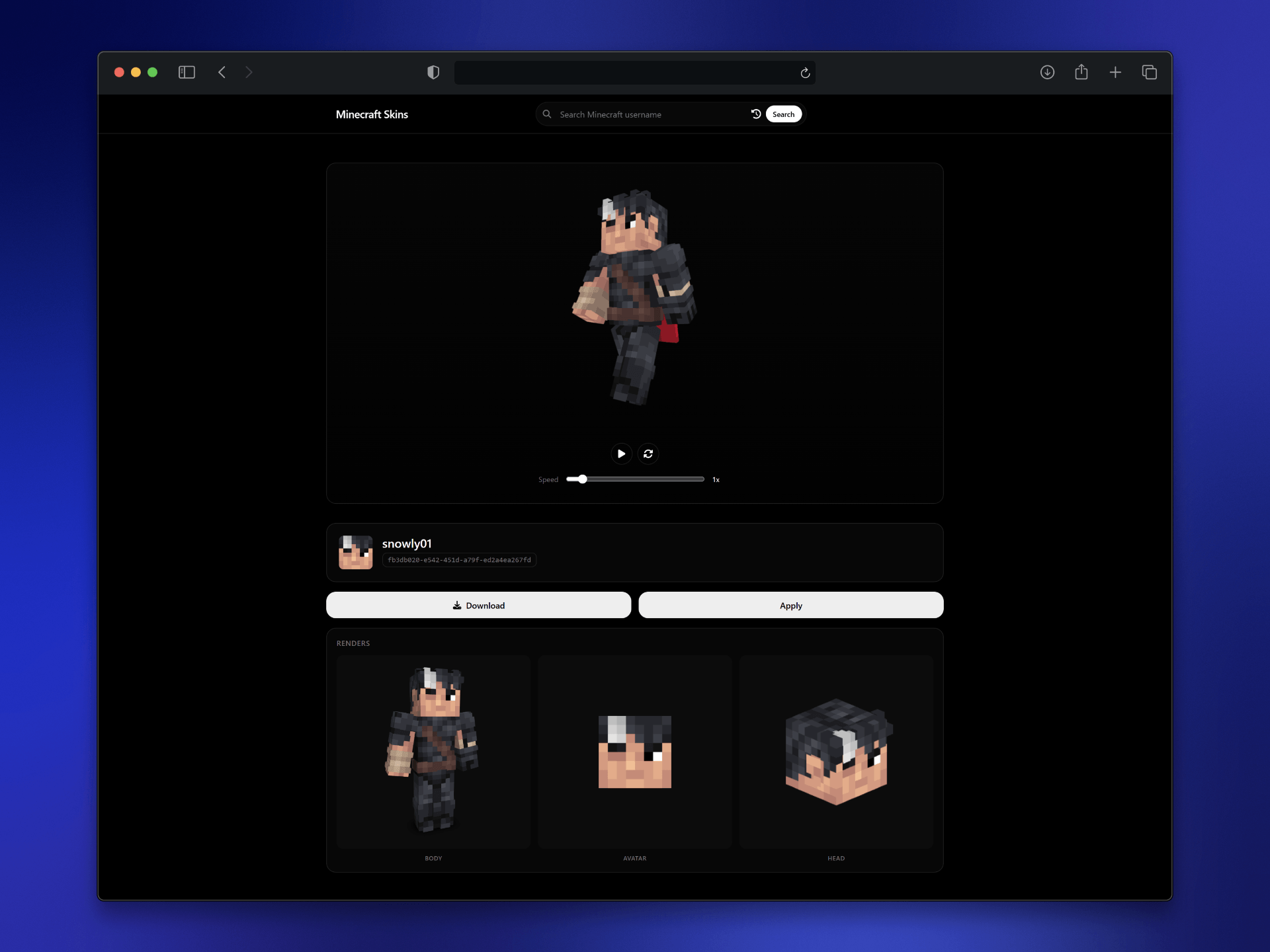
A 3D skin viewer and management tool that connects my early passion for Minecraft with modern web development.
The Motivation: Full Circle
My journey into programming didn't start with textbooks; it started with a desire to customize the digital spaces I inhabited. It began with Tumblr themes, where I first realized I could bend the web to my aesthetic will. That "spark" quickly led me to Minecraft—a game where I spent countless hours tweaking plugins, messing with mods, and obsessing over character skins.
As I grew older and shifted my focus toward formal engineering and professional frontend work, I naturally moved away from the game. This project is a way to pay homage to those roots. It’s a clean, modern tool built to apply everything I’ve learned about APIs and 3D rendering to the playground that helped shape my curiosity.
The Project
Minecraft Skins is a web-based application that allows users to preview any Minecraft skin in a fully interactive 3D environment. Whether you want to check your own current look or find inspiration from others, the app provides a seamless way to view, rotate, and download skins directly from Mojang's servers.
Key Features
- Interactive 3D Rendering: Powered by
skinview3d, the app offers a high-fidelity preview with speed control, pausing, and manual rotation. - User-First Search: Simply type a username to fetch their current skin.
- Direct Integration: Options to download the skin file or apply it directly to your Minecraft account.
- Evolution of APIs: Originally built using various third-party services (like PlayerDB and MineTools), I recently updated the project to depend directly on official Mojang services to ensure long-term stability.
Learning Outcomes
Beyond the nostalgia, this project was a playground for:
- API Orchestration: Handling multiple external data sources and managing fallback logic when a service went down.
- 3D Library Implementation: Learning how to integrate and customize specialized rendering libraries within a standard web workflow.
- Legacy Maintenance: Returning to a project years later to refactor it (as I did in October 2025) is a great exercise in reading your own "old" code and making it better.
Tech Stack
- HTML/JS/CSS: The core foundation.
- Bootstrap: For a quick, responsive layout.
- skinview3d: The heavy lifter for the 3D model.
- Mojang APIs: For real-time skin and player data fetching.